
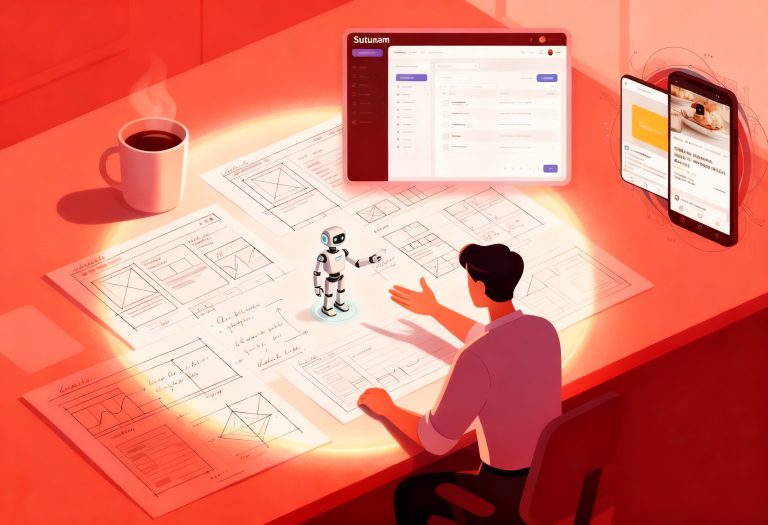
There’s a version of the future where every startup generates its app screens with a prompt. The logo is on-brand. The buttons are in the right places. The prototype exists in minutes. And yet, something is missing.
We built the UX/UI for Yummix, a Thermomix recipe platform with 170,000 Instagram followers and a decade of content, into a native mobile app. The project taught us something we want to say out loud: AI is a powerful accelerator. It is not a replacement for expert design thinking.
The problem was never visual
Yummix didn’t need prettier screens. They needed a rethink of how a web platform built over 10 years could translate to a kitchen context: one hand busy, timer running, recipe mid-step. That kind of UX challenge isn’t solved by generating mockups. It’s solved by asking the right questions first.
We ran workshops to map real cooking behaviors. We audited subscription flows, browsing patterns, and shopping list logic before touching any design tool. This is the work AI cannot shortcut: understanding a user’s intent in a physical context, aligning it with a business model, and translating it into a frictionless interaction.
Design systems, accessibility standards, cross-platform constraints: these require judgment, not just generation. The best AI tools amplify a skilled designer. They don’t replace one.
Speed without shortcuts
We delivered a fully interactive prototype, validated across all user journeys, in 10 days. That speed came from a tight process, not from cutting corners. High-fidelity wireframes, an atomic design system, and complete technical documentation for the React Native handoff to Bear Studio.
Days to prototype
Dev-ready components
Store rating
The cross-platform challenge was real: the design system had to anticipate a React Native mobile build, a Symfony API, and future Magento eCommerce integrations. No AI tool reasons across those constraints simultaneously. A senior designer with architecture awareness does.
AI helps. Expertise decides.
We use AI tools in our process: for exploration, for iteration speed, for generating variations. But the moment a product has real users, a real business model, and real technical constraints, you need a human who can hold all of that in their head and make a judgment call.
Yummix is now live on the App Store and Google Play with a 5-star rating. That didn’t happen because the screens look good. It happened because the experience was designed with intent, from audit to atomic component, from workshop to handover.
If you’re building a mobile product and wondering whether great design still matters in the age of AI: it does. Possibly more than ever.
→ Read the full Yummix case study · Explore our UX/UI services
Planning a mobile product? Let’s talk about your UX foundation.
 Art Director & UX Designer at Sutunam, Christophe crafts digital interfaces that go beyond aesthetics, combining visual direction with user research and strategy to create experiences that truly resonate.